


Marxism And Law
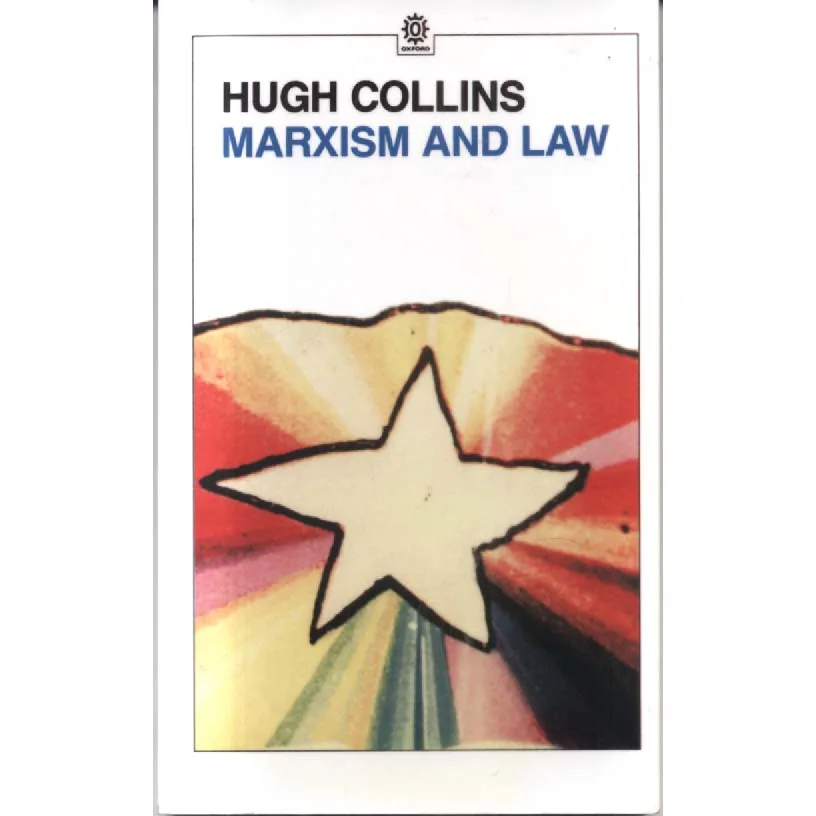
Publisher: Oxford University Press
Format: Paperback
ISBN: 9780192851444
Marxism and Law is one of those splendidly uncompromising titles that sounds less like a book and more like a challenge. It does not sidle up to the reader with anecdotes, glossy diagrams, or promises of instant transformation. It simply places two enormous, slightly alarming concepts on the cover and waits to see who is brave enough to continue. Fortunately, Hugh Collins is an excellent guide through this rather serious territory, and what might at first seem like a forbidding slab of theory turns out to be a sharp, provocative, and surprisingly lively exploration of what law is really doing when it pretends merely to be law.
Because that, of course, is the whole fun of it. Law likes to present itself as neutral, sober, above the fray: a calm referee in a wig, blowing a whistle over society’s various unfortunate collisions. Marxism, by contrast, strolls in and asks whether the referee might in fact be employed by the stadium owners, trained by the same people who sold the tickets, and perhaps quietly invested in the outcome. Collins takes that tension seriously and examines how legal systems relate to power, class, capitalism, property, contracts, and all the other respectable mechanisms by which modern life keeps itself looking orderly while quietly arranging who gets what.
This is not to say the book is all revolutionary thunder and abstract slogans. Quite the opposite. Its intelligence lies in its calmness. Rather than simply shouting that law is an instrument of domination and calling it a day, Collins works through the arguments with care, clarity, and a proper scholar’s patience. He looks at the ways Marxist thinkers have interpreted law, the problems in those interpretations, and the awkward reality that legal systems can appear both oppressive and protective at the same time. Which is inconvenient, certainly, but also what makes the whole subject interesting.
And interesting it is, in the best possible way. This is the sort of book that quietly rearranges how you look at ordinary things. Contracts stop seeming like mere paperwork and start looking like little capsules of economic power. Property law begins to resemble not a natural fact but a carefully maintained social arrangement. Rights, duties, obligations, institutions—all the stately furniture of legal life—suddenly acquire hidden hinges and suspicious foundations. One starts out reading about jurisprudence and ends up peering at society itself like a detective inspecting a very respectable drawing room for bloodstains.
There is also something wonderfully British about this kind of Oxford University Press paperback: compact, serious, quietly formidable, and entirely unbothered by the possibility that some readers might prefer not to think too hard. It belongs to that noble tradition of books that assume intelligence rather than trying to flatter it. No neon promises, no desperate simplifications, just a proper engagement with difficult ideas. In a more vulgar age, that feels almost heroic.
As sold by Crappy Old Books, this Good condition copy has exactly the right sort of dignity. It has likely survived student essays, late-night underlining, legal-theory seminars, ideological enthusiasm, ideological disillusionment, and perhaps a few arguments beginning with the phrase “well, actually, if you read Collins…” It now waits for a new owner: perhaps a law student wanting to complicate their understanding of the subject, perhaps a political reader curious about legal structure, or perhaps simply someone who enjoys books that make capitalism feel less like weather and more like design.
What makes Marxism and Law especially satisfying is that it inhabits that fine space between doctrine and doubt. It is not merely a hymn to one worldview, nor a smug dismissal of it. Instead, it is an intelligent working-through of a powerful tradition of criticism, asking what Marxism can reveal about law without pretending the answers are always neat. That gives it real life. It argues, questions, probes, and keeps the machinery turning.
So here we have a book for readers who like their paperbacks thoughtful, unsettling, and faintly subversive. A book that politely removes the mask from legal neutrality, then hands it back and asks you to inspect the stitching. In short: an excellent volume for anyone interested in law, politics, power, or the cheerful destruction of simplistic assumptions. Crappy Old Books is, naturally, delighted to offer exactly this sort of compact intellectual grenade.
Keep browsing: See more Politics books Other books by Hugh Collins
